Chromium(II) has a high-spin d4 configuration (t2g3eg1) with weak-field HX2O ligands, giving a total spin S=2 and a free-ion ground term of 5D. In an octahedral field, the single eg electron above the spherically symmetric half-filled t2g3 subshell makes the lower-energy crystal field state 5Eg. Option B (5T2g) is the higher-energy excited state, while options C and D have the multiplicity 6 characteristic of high-spin d5.
The reaction of XeFX2 with HN(SOX2F)X2 at 273 K in CFX2ClX2 solvent yields
AXeFX4+SOX2+NHX3
BXe+SOX2+NX2+HF
CSOFX2+XeOX2+NHX3
DFXeN(SOX2F)X2+HF
Show answer and explanation
Answer: D. FXeN(SOX2F)X2+HF
At 273 K, the strongly acidic amine HN(SOX2F)X2 undergoes a protolytic displacement with XeFX2 to eliminate HF, forming a xenon-nitrogen bond in FXeN(SOX2F)X2. Mild conditions prevent the complete reduction of Xe(II) to Xe(0), making the redox breakdown in option B incorrect.
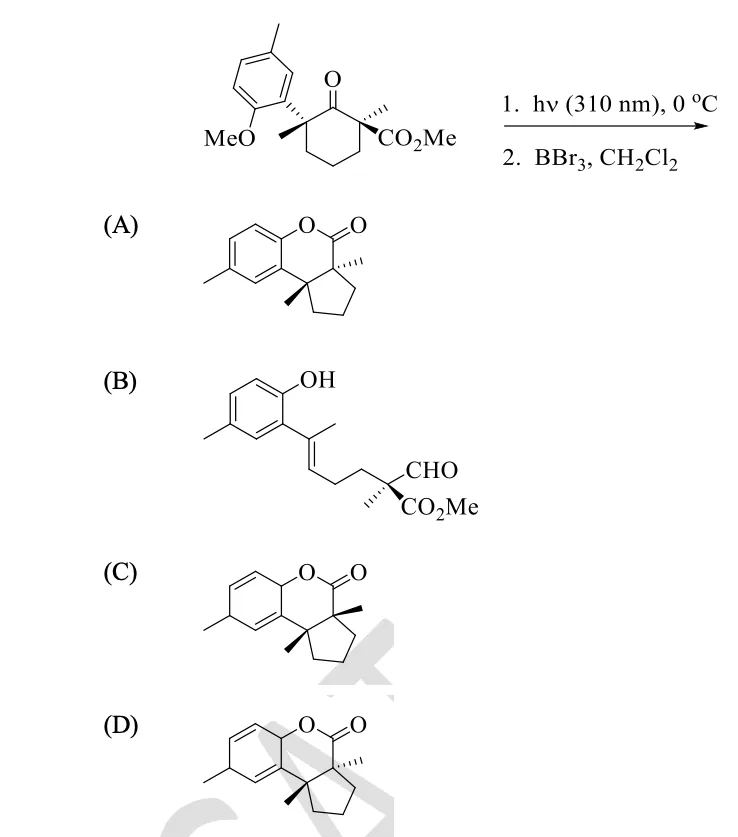
Photolysis of the α,α′-tetrasubstituted cyclohexanone triggers a Norrish Type I cleavage, generating two stable tertiary radical centers. Subsequent extrusion of CO and radical recombination causes ring contraction to form a substituted cyclopentane derivative. In the second step, BBrX3 demethylates the aryl ether to yield a free phenol, which undergoes spontaneous intramolecular lactonization with the adjacent methyl ester to give the tricyclic lactone (A). Option B fails because decarbonylation followed by ring closure is highly favored over disproportionation.
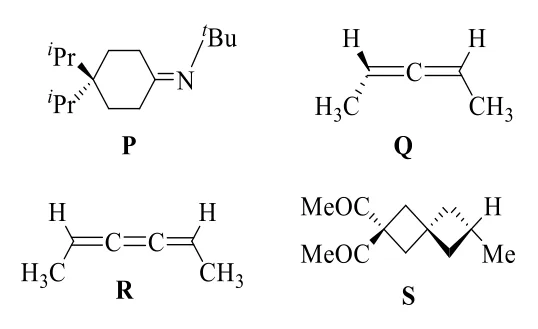
Penta-2,3-diene (Q) is an allene with an even number of cumulated double bonds, so the substituents at the two terminal spX2 carbons lie in mutually perpendicular planes. Because each end carries two different groups (−H and −CHX3), it lacks a plane or center of inversion (C2 symmetry) and is axially chiral. Butatriene R has an odd number of cumulated double bonds, making all substituents coplanar and the molecule achiral. In P and S, planes of symmetry bisecting the identical geminal substituents render them achiral.
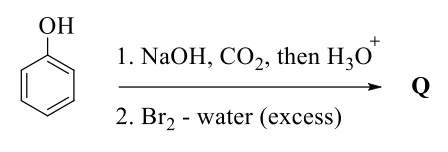
The major product in the given reaction sequence is Q. The mass spectrum of Q shows
([M] = molecular ion peak)
A[M], [M+2], [M+4], and [M+6] peaks with relative intensity of 1:1:1:1
B[M], [M+2], [M+4], and [M+6] peaks with relative intensity of 1:3:3:1
C[M], [M+2], and [M+4] peaks with relative intensity of 1:2:1
D[M] and [M+2] peaks with relative intensity of 1:1
Show answer and explanation
Answer: B. [M], [M+2], [M+4], and [M+6] peaks with relative intensity of 1:3:3:1
The Kolbe-Schmitt reaction first converts phenol to salicylic acid. Treatment with excess BrX2-water causes electrophilic aromatic bromination accompanied by bromodecarboxylation to yield 2,4,6-tribromophenol. Because bromine has two nearly equal-abundance isotopes (79Br and 81Br, 1:1), the presence of three bromine atoms results in a binomial (1+1)3 distribution of 1:3:3:1 for [M], [M+2], [M+4], and [M+6]. Option C incorrectly assumes the carboxyl group remains intact to give a dibrominated product.
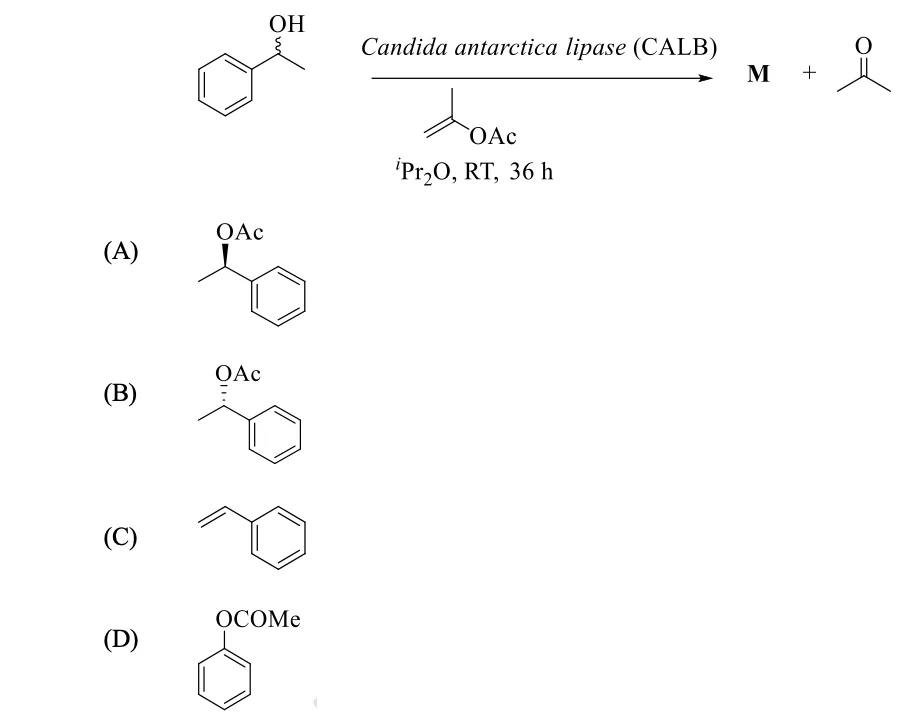
*Candida antarctica* lipase B (CALB) follows Kazlauskas' rule, preferentially acylating the (R)-enantiomer of secondary alcohols containing a large group (Ph) and a medium group (Me). Transesterification with isopropenyl acetate selectively converts (R)-1-phenylethanol into (R)-1-phenylethyl acetate, releasing acetone as a tautomeric byproduct. Option B represents the (S)-enantiomer, which reacts much slower and remains largely unesterified during kinetic resolution.
Critical micellar concentration of a surfactant is 0.008 M in water at 25∘C. If the aggregation number of the micelles is 80, the concentration of the micelles (in M) present in 0.088 M aqueous solution of the surfactant at 25∘C is
A0.010
B0.001
C0.008
D0.088
Show answer and explanation
Answer: B. 0.001
The concentration of surfactant present in micellar form is the total concentration above the CMC, given by C−CMC=0.088 M−0.008 M=0.080 M. Dividing this value by the aggregation number of 80 gives the micelle concentration as (0.080 M)/80=0.001 M. Option A results from a tenfold arithmetic error in dividing by 80.
The order and the number of classes present in a group with the irreducible representations A1, A2, B1, B2, E1, and E2, are, respectively,
A6 and 6
B12 and 6
C6 and 3
D12 and 3
Show answer and explanation
Answer: B. 12 and 6
The number of classes equals the number of irreducible representations, which is 6. The order of the group is the sum of the squares of the dimensions of all irreducible representations: $h = u(\text{A}_1)^2 + u(\text{A}_2)^2 + u(\text{B}_1)^2 + u(\text{B}_2)^2 + u(\text{E}_1)^2 + u(\text{E}_2)^2 = 1^2 + 1^2 + 1^2 + 1^2 + 2^2 + 2^2 = 12$. Option A incorrectly assumes the group order is simply the count of irreducible representations.
The molecule XYX2 is microwave active and its vibration-rotation spectrum shows only P and R transitions. In the correct structure,
AX is the central atom in linear XYX2.
BX is the central atom in bent XYX2.
CY is the central atom in linear XYX2.
DY is the central atom in bent XYX2.
Show answer and explanation
Answer: C. Y is the central atom in linear XYX2.
Microwave activity requires a permanent dipole moment (μ=0), ruling out symmetric linear Y−X−Y (option A) which is nonpolar. The presence of only P and R branches (no Q branch, ΔJ=±1) signifies a parallel transition of a linear molecule rather than an asymmetric top bent structure (options B and D). Thus, the molecule must be non-centrosymmetric and linear, meaning Y is the central atom in an X−Y−Y arrangement.
The complex(es) with distorted octahedral structure is (are)
A[VFX6]X3−
B[FeFX6]X3−
C[MnFX6]X3−
D[Fe(CN)X6]X4−
Show answer and explanation
Answer: A. [VFX6]X3− C. [MnFX6]X3−
Distortion from a regular octahedral geometry occurs via the Jahn-Teller effect when the degenerate electronic ground state is asymmetrically occupied. In [VFX6]X3− (VX3+, d2, t2g2eg0) and [MnFX6]X3− (MnX3+, high-spin d4, t2g3eg1), the orbitally degenerate t2g and eg levels cause distortion. Conversely, options B (FeX3+, high-spin d5, t2g3eg2) and D (FeX2+, low-spin d6, t2g6eg0) have symmetrically filled subshells, resulting in regular, undistorted octahedral geometries.
54 more questions from this paper are in the app
In the Tatva app you get the whole paper with the real clock and marking, every answer explained, your score, and an AI tutor for each mistake.