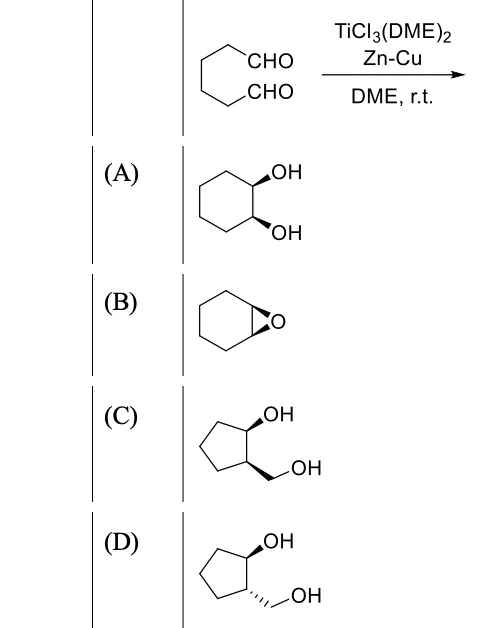
The reaction is an intramolecular pinacol coupling of hexane-1,6-dial mediated by low-valent titanium (TiII/Ti0 generated from TiCl3(DME)2 and Zn-Cu). At room temperature, deoxygenation to an alkene is suppressed, and coupling of the two carbonyl carbons forms a six-membered ring. Chelation of both carbonyl oxygens to the titanium template directs their pinacol coupling stereoselectively to yield the *cis*-diol (A). The five-membered ring derivatives (C) and (D) are avoided because reductive coupling occurs directly between the two terminal carbonyl carbons.
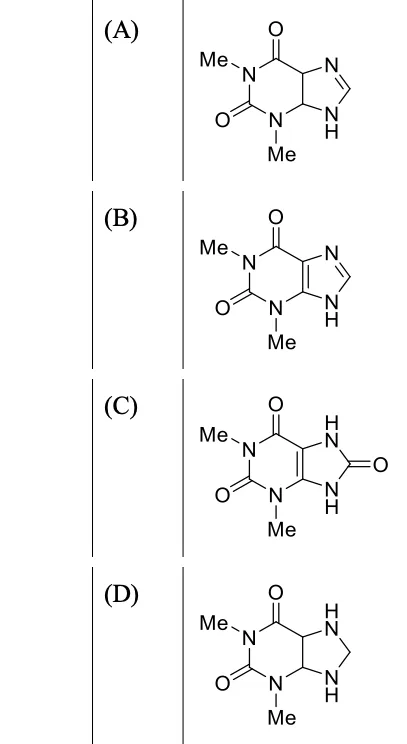
The compound which gives a fragment at m/z=124[M+H]+ is
AStructure (A)
BStructure (B)
CStructure (C)
DStructure (D)
Show answer and explanation
Answer: B. Structure (B)
Compound (B) is theophylline (MW=180), which forms a protonated precursor ion [M+H]+ at m/z=181. In mass spectrometry, it undergoes a characteristic retro-cleavage with loss of methyl isocyanate (MeNCO, 57Da) from the pyrimidinedione ring to give the prominent fragment ion at m/z=181−57=124. The saturated derivatives in (A) and (D) have different molecular weights, while (C) contains an extra carbonyl (MW=196) and cannot yield this fragment.
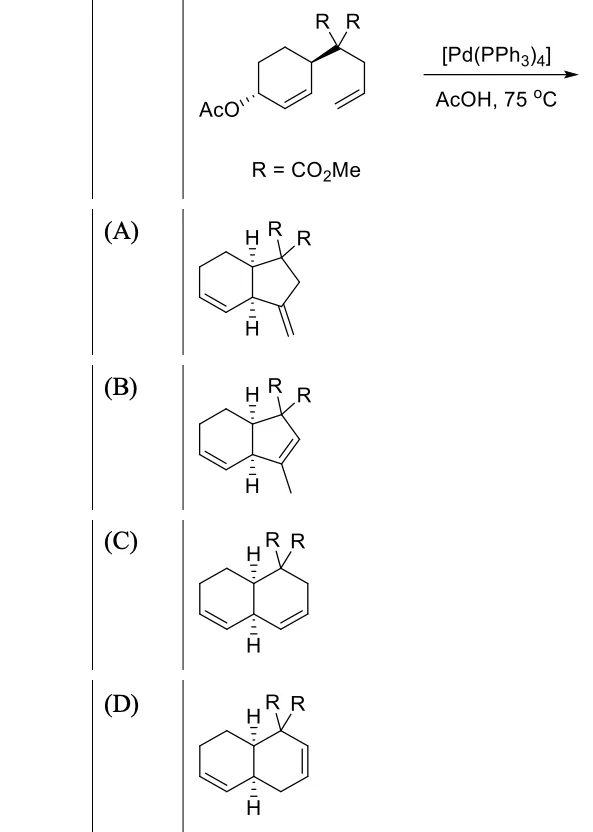
The reaction is an intramolecular palladium-catalyzed Alder-ene cyclization. Oxidative addition of Pd(0) to the allylic acetate generates a (π-allyl)Pd intermediate, which undergoes preferential 5-exo-trig carbopalladation with the pendant unactivated alkene to construct the hydrindane core. Subsequent β-hydride elimination from the resulting methyl-Pd intermediate delivers the 1,4-diene containing an exocyclic methylene unit. Options C and D arise from the kinetically disfavored 6-endo pathway, while option B requires an endocyclic double-bond isomerization.
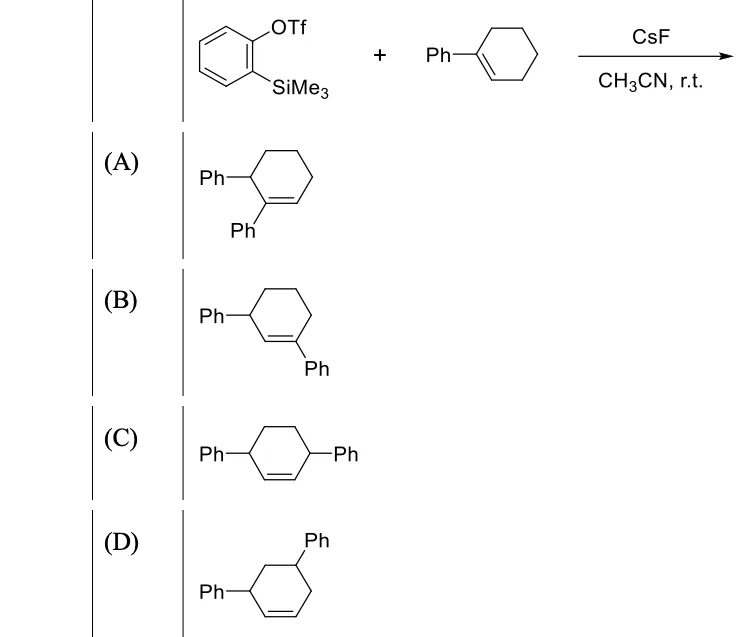
Fluoride-induced elimination of 2-(trimethylsilyl)phenyl trifluoromethanesulfonate generates benzyne in situ, which undergoes a concerted ene reaction with 1-phenylcyclohexene. Benzyne acts as the enophile and attacks the less hindered CX2 carbon of the alkene while abstracting an allylic hydrogen from CX6. This shifts the double bond to CX1=CX6, yielding the allylically substituted product (A). Option B has an incorrect regiochemical disposition that cannot arise from this concerted pathway.
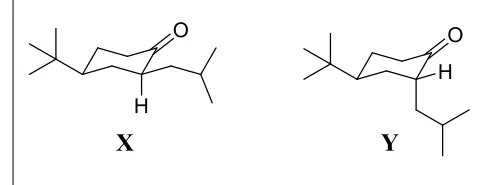
On irradiation using UV light (>300 nm), compounds X and Y, predominantly, undergo
AX: Norrish type I reaction and Y: Norrish type II reaction
BX: Norrish type II reaction and Y: Norrish type I reaction
CBoth X and Y: Norrish type I reaction
DBoth X and Y: Norrish type II reaction
Show answer and explanation
Answer: B. X: Norrish type II reaction and Y: Norrish type I reaction
Norrish type II cleavage requires the carbonyl oxygen to abstract a γ-hydrogen through a six-membered cyclic transition state, which is geometrically accessible only when the side chain aligns with the in-plane n-orbital of the carbonyl group. In X, the isobutyl group is equatorial, allowing facile intramolecular γ-H abstraction to undergo a Norrish type II reaction. In Y, the isobutyl group is axial, preventing this cyclic transition state and leaving α-cleavage (Norrish type I) as the dominant pathway. Option A reverses this conformational preference.
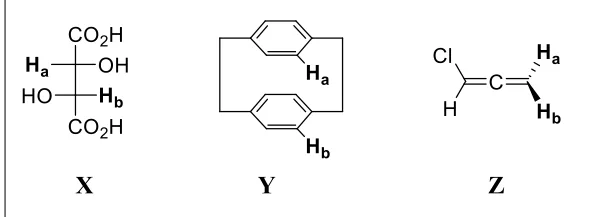
The topicity relationship of Ha and Hb in X, Y and Z are, respectively,
ADiastereotopic, Homotopic and Enantiotopic
BHomotopic, Enantiotopic and Enantiotopic
CHomotopic, Homotopic and Enantiotopic
DDiastereotopic, Enantiotopic and Homotopic
Show answer and explanation
Answer: B. Homotopic, Enantiotopic and Enantiotopic
In X, a C2 axis perpendicular to the Fischer projection interconverts Ha and Hb, making them homotopic. In Y, the horizontal mirror plane (σ) between the two decks relates Ha and Hb without any proper rotation axis interconverting them, so they are enantiotopic. In allene Z, the plane containing Cl−C−H bisects the HXa−C−HXb angle, making them enantiotopic. Option A fails because X has a C2 axis, ruling out diastereotopicity.
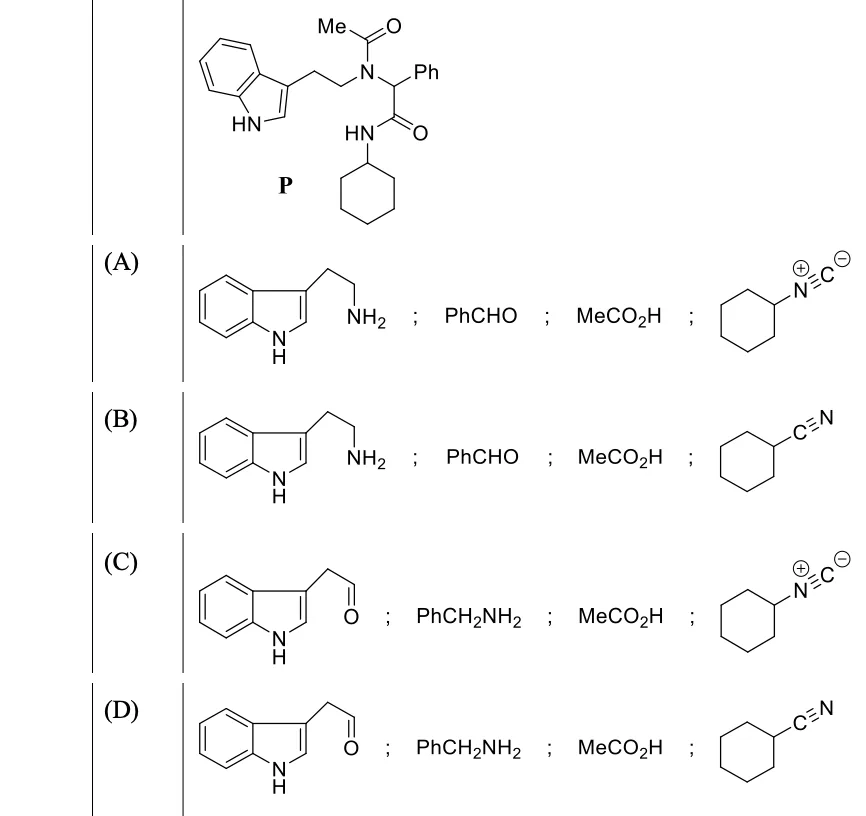
Compound P was prepared based on a four-component reaction at room temperature in methanol. The required starting materials for the synthesis are
AStructure (A)
BStructure (B)
CStructure (C)
DStructure (D)
Show answer and explanation
Answer: A. Structure (A)
The target bis-amide P is synthesized via the classic Ugi four-component reaction (U-4CR) involving a primary amine, an aldehyde, a carboxylic acid, and an isocyanide. Deconstruction reveals tryptamine as the amine component, benzaldehyde (PhCHO) as the aldehyde, acetic acid (MeCOX2H) as the acid, and cyclohexyl isocyanide as the isocyanide. Option B incorrectly uses a nitrile (Cy−CN) instead of an isocyanide, while Option C reverses the positions of the indole and phenyl substituents.
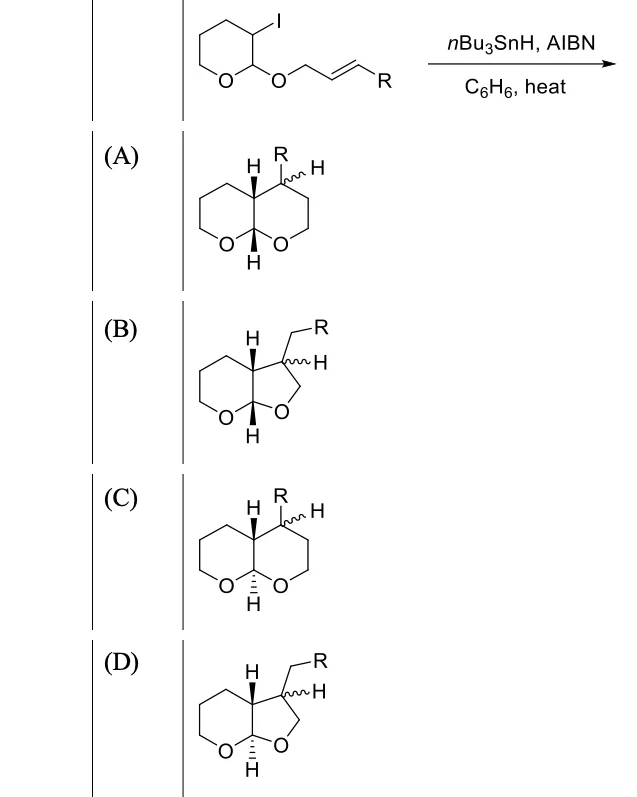
The major product formed in the following reaction is
AStructure (A)
BStructure (B)
CStructure (C)
DStructure (D)
Show answer and explanation
Answer: B. Structure (B)
Homolytic cleavage of the C−I bond by nBuX3SnX∙ generates a C3-centered radical, which undergoes a kinetically favored 5-exo-trig cyclization onto the tethered alkene rather than 6-endo-trig cyclization (ruling out A and C). The resulting bicyclo[4.3.0] system adopts the thermodynamically and stereochemically preferred cis-ring fusion to minimize ring strain, making the bridgehead hydrogens syn to each other as in B rather than anti as in D.
The reaction of PhX3PClX2 with PhNHX2 primarily produces
APhX3P=NPh
BPhP=NPh
CPhClX2P=NPh
DPhX2ClP=NPh
Show answer and explanation
Answer: A. PhX3P=NPh
The reaction of dichlorotriphenylphosphorane (PhX3PClX2) with aniline (PhNHX2) is a classic Kirsanov reaction, yielding the iminophosphorane (phosphazene) PhX3P=NPh via the elimination of two equivalents of HCl: PhX3PClX2+PhNHX2PhX3P=NPh+2HCl. The three phenyl groups on phosphorus remain intact throughout substitution, ruling out species with altered phenyl or chlorine counts such as option D.
Formation of [M(en)X3]X2+ from [M(HX2O)X6]X2+ and three equivalents of ethylenediamine (en) is LEAST favored when M is
ACo
BNi
CCu
DFe
Show answer and explanation
Answer: D. Fe
According to the Irving-Williams series, the overall stability constants (β3) for high-spin divalent transition metal complexes follow the order FeX2+<CoX2+<NiX2+<CuX2+. Consequently, FeX2+ has the lowest overall formation constant (logβ3≈9.5) and the least favorable reaction free energy. Option C is a common pitfall because strong Jahn-Teller elongation severely suppresses the third stepwise constant K3 of CuX2+, yet its cumulative constant (logβ3≈18.6) still vastly exceeds that of FeX2+.
55 more questions from this paper are in the app
In the Tatva app you get the whole paper with the real clock and marking, every answer explained, your score, and an AI tutor for each mistake.