In a moving coil galvanometer, the deflection θ of the coil is related to the electric current i by the relation
Ai∝tanθ
Bi∝θ
Ci∝θ2
Di∝θ
Show answer and explanation
Answer: B. i∝θ
With a radial magnetic field the deflecting torque NiAB balances the restoring torque Cθ, so i=(C/NAB)θ, a linear relation. i∝tanθ belongs to the tangent galvanometer.
In Young's double slit experiment, the fringe width is found to be 0.4 mm. If the whole apparatus is immersed in water of refractive index 34, without disturbing the geometrical arrangement, the new fringe width will be
A0.30 mm
B0.40 mm
C0.53 mm
D450 mm
Show answer and explanation
Answer: A. 0.30 mm
Wavelength in water is λ/μ, so β′=β/μ=0.4×3/4=0.30 mm. Multiplying by μ instead gives the tempting 0.53 mm.
A particle of mass m moving with constant velocity v strikes another particle of the same mass m moving with the same speed v in the opposite direction, and they stick together. The joint velocity after collision will be
Av
B2v
Czero
D2v
Show answer and explanation
Answer: C. zero
Total momentum before is mv−mv=0, so the combined body is at rest. v/2 would apply only if the second particle were initially at rest.
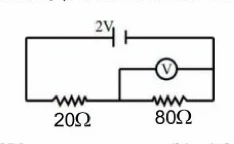
In the circuit shown in the figure, the e.m.f. of the cell is 2 V and its internal resistance is negligible. A 20Ω and an 80Ω resistor are in series with the cell, and a voltmeter of resistance 80Ω is connected across the 80Ω resistor. The reading of the voltmeter will be
A0.80 V
B1.33 V
C1.60 V
D2.00 V
Show answer and explanation
Answer: B. 1.33 V
The voltmeter in parallel with 80Ω gives 40Ω; with 20Ω in series the current is 2/60 A, so the reading is 40/30≈1.33 V. 1.60 V ignores the voltmeter's own resistance.
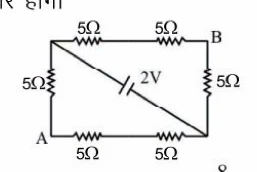
In the circuit shown in the figure, the potential difference between points A and B will be
A32 V
B98 V
C34 V
D2 V
Show answer and explanation
Answer: A. 32 V
The 2 V cell lies on the diagonal; each of the two paths around it has 15Ω and carries 2/15 A. Taking the cell's negative corner as 0, A is at 4/3 V and B at 2/3 V, so VA−VB=2/3 V. 4/3 V is the potential of A alone.
76 more questions from this paper are in the app
In the Tatva app you get the whole paper with the real clock and marking, every answer explained, your score, and an AI tutor for each mistake.