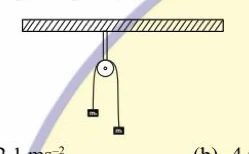
Two masses m1 and m2 are attached to a string which passes over a frictionless fixed pulley as shown in the figure. If m1=7kg, m2=3kg and g=10m s−2, the acceleration of the masses is:
A2.1m s−2
B4m s−2
C42m s−2
D10m s−2
Show answer and explanation
Answer: B. 4m s−2
a=m1+m2(m1−m2)g=104×10=4m s−2. 10 m s−2 would be free fall, ignoring the opposing mass.
A stone thrown upward with speed u attains a maximum height h. Another stone thrown upward from the same point with speed 3u attains a maximum height H. The relation between h and H is:
A2h=H
B5h=H
C7h=9H
D9h=H
Show answer and explanation
Answer: D. 9h=H
Maximum height u2/2g grows as the square of the launch speed, so tripling the speed gives H=9h. 5h or 2h come from not squaring the factor.
Match List I (names of scientists) with List II (laws of physics). List I: (P) Galileo, (Q) Michael Faraday, (R) Isaac Newton, (S) Andre Ampere ; List II: (A) Laws of gravitation and motion, (B) Laws of electromagnetism, (C) Laws of falling bodies, (D) Laws of electromagnetic induction
AP-C, Q-D, R-A, S-B
BP-A, Q-B, R-C, S-D
CP-C, Q-B, R-A, S-D
DP-A, Q-D, R-C, S-B
Show answer and explanation
Answer: A. P-C, Q-D, R-A, S-B
Galileo studied falling bodies, Faraday discovered electromagnetic induction, Newton gave the laws of motion and gravitation, and Ampere worked on electromagnetism (currents and magnetic forces). Option (b) wrongly gives Newton electromagnetism.
The distance of a geostationary satellite from the centre of the earth of radius R is:
A6.6R
B7R
C8R
D5R
Show answer and explanation
Answer: A. 6.6R
A geostationary satellite is about 36,000 km above the surface, i.e. about 42,000 km or 6.6R from the earth's centre. 5.6R is its height above the surface, not its distance from the centre.
The apparent weight of a boy in a lift is less than his real weight when the lift is going:
Aup with an acceleration
Bup with a constant velocity
Cdown with a constant velocity
Ddown with an acceleration
Show answer and explanation
Answer: D. down with an acceleration
Accelerating downward, the normal reaction is m(g−a)<mg. Constant velocity in either direction leaves the apparent weight equal to the real weight, and upward acceleration increases it.
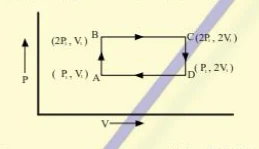
An ideal gas is taken around the cycle ABCDA in the P-V diagram, where the coordinates are A(P1,V1), B(2P1,V1), C(2P1,2V1) and D(P1,2V1). The work done during the cycle is:
AP1V1
B2P1V1
C21P1V1
DZero
Show answer and explanation
Answer: A. P1V1
Work in a cycle equals the enclosed area: (2P1−P1)(2V1−V1)=P1V1, positive since the cycle is clockwise. Zero is wrong because a cycle with nonzero area does net work.
67 more questions from this paper are in the app
In the Tatva app you get the whole paper with the real clock and marking, every answer explained, your score, and an AI tutor for each mistake.