The total number of lone pairs of electrons on all the atoms in cyanogen azide and thiocyanogen respectively, are
A4 and 6
B6 and 6
C3 and 4
D4 and 4
Show answer and explanation
Answer: A. 4 and 6
Cyanogen azide (N–C–N3) has 24 valence electrons (12 pairs): 8 bonding pairs in :N≡C−N¨=N+=N¨− leave 4 lone pairs (one on the cyano N, one on the internal azide N, and two on the terminal N). Thiocyanogen (N≡C–S–S–C≡N) has 30 valence electrons (15 pairs) with 9 bonding pairs, leaving 6 lone pairs (two on each S and one on each N). Option B incorrectly counts extra lone pairs on cyanogen azide.
Of the following statements regarding dissociative substitution in an octahedral transition metal complex, (a) High steric hindrance between ligands in the metal complex favors fast dissociation of ligand. (b) Increased charge on the metal atom/ion of the complex favours the acceptance of electron pair of the entering ligands. (c) A pentacoordinated intermediate is observed. (d) Nature of the entering ligand significantly influences the reaction. Which are correct?
Aa and d
Ba and c
Ca, c and d
Da, b, c and d
Show answer and explanation
Answer: B. a and c
In a dissociative (D) mechanism, the rate-determining step is ligand loss from the octahedral complex to form a pentacoordinated intermediate, which is accelerated by steric crowding that relieves ligand-ligand repulsion (making (a) and (c) correct). Since the entering ligand enters after this slow step, its nature has little to no effect on the reaction rate, ruling out (d). Option C wrongly includes (d), which actually characterizes associative substitution.
For [HgX2]X2+, the bond order and the orbitals involved in bonding are, respectively
Aone; s and s
Btwo; s and p
Cone; p and p
Dthree; s and d
Show answer and explanation
Answer: A. one; s and s
Each HgX+ ion has a valence electron configuration of 5d106s1. The two half-filled 6s orbitals overlap to form a σ bonding molecular orbital containing two electrons, giving σ(6s)2 with no electrons in the antibonding orbital, so the bond order is (2−0)/2=1. The bonding primarily involves s and s orbitals; Option C is incorrect because the 6p orbitals are vacant and lie higher in energy.
Consider following statement(s) in the context of NO and CO ligands A. In the bent mode, NO donates three electrons to the metal center. B. In IR spectrum, the νNO for the bent nitrosyl ligand typically lies between 1525 and 1690 cm−1. C. The HOMO of NO and CO are π∗ and σ orbitals, respectively.
AA only
BB and C
CA and C
DA and B
Show answer and explanation
Answer: B. B and C
In the neutral counting method, bent NO behaves as a 1-electron donor (or 2-electron donor as NOX− in the ionic method), whereas linear NO donates 3 electrons, making statement A incorrect and ruling out option C. Bent nitrosyl has a lower N−O bond order, showing a typical IR stretching frequency νNO in the range 1525–1690 cm−1. Furthermore, the highest occupied molecular orbital is π∗ for the radical NO and a carbon-centered non-bonding σ orbital for CO, confirming statements B and C.
Answer: D. Xe acts as a base and XeFX4 acts as an acid.
In the first reaction, Xe donates electron density to the strong oxidizing agent PtFX6 to form [Xe]X+, acting as a Lewis base (electron donor). In the second reaction, XeFX4 accepts a fluoride ion (FX−) from MeX4NF to form [XeFX5]X−, acting as a Lewis acid (fluoride acceptor). Option B incorrectly classifies XeFX4 as a base despite it accepting an electron pair from FX−.
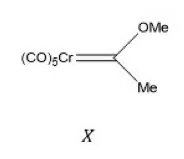
Consider the following statement(s) in the context of organometallic complex (X):
A. The carbene ligand donates two electrons to the metal and accepts d electrons to make a π-bond B. The C (carbene) is nucleophilic C. Rotation around the Cr=C(OMe)Me double bond has low barrier (<10 kcal/mol) Correct statement(s) is/are:
AA and B
BA only
CA and C
DB and C
Show answer and explanation
Answer: C. A and C
Complex X is a Fischer carbene where the singlet carbene acts as a σ-donor and π-acceptor, making statement A correct. The carbene carbon is electrophilic, not nucleophilic, which eliminates statement B and options A and D. Strong π-donation from the methoxy oxygen lone pair into the carbene p-orbital significantly reduces the Cr−Cπ-bonding character, resulting in a very low barrier to rotation around the Cr=C bond (<10 kcal/mol, statement C).
The penetrating power (R) and ionizing power (I) of α, β, and γ rays follow the ordering
ARβ>Rγ>Rα and Iβ>Iγ>Iα
BRγ>Rβ>Rα and Iβ>Iγ>Iα
CRβ>Rα>Rγ and Iα>Iβ>Iγ
DRγ>Rβ>Rα and Iα>Iβ>Iγ
Show answer and explanation
Answer: D. Rγ>Rβ>Rα and Iα>Iβ>Iγ
Ionizing power depends on mass and charge: massive, doubly charged α particles interact most strongly with matter, giving the order Iα>Iβ>Iγ. Because radiation that ionizes readily loses energy over shorter distances, penetrating power follows the inverse trend, Rγ>Rβ>Rα. Option B is incorrect because it incorrectly ranks β rays as having greater ionizing power than α rays.
For the ligand-to-metal charge-transfer (LMCT) transitions in the oxo-anions given below, the wavelength of the transitions are in the order
AVOX4X3−<CrOX4X2−<MnOX4X− and WOX4X2−<MoOX4X2−<CrOX4X2−
BVOX4X3−<CrOX4X2−<MnOX4X− and WOX4X2−>MoOX4X2−>CrOX4X2−
CVOX4X3−>CrOX4X2−>MnOX4X− and WOX4X2−<MoOX4X2−<CrOX4X2−
DVOX4X3−>CrOX4X2−>MnOX4X− and WOX4X2−>MoOX4X2−>CrOX4X2−
Show answer and explanation
Answer: A. VOX4X3−<CrOX4X2−<MnOX4X− and WOX4X2−<MoOX4X2−<CrOX4X2−
Across the isoelectronic series VOX4X3−, CrOX4X2−, and MnOX4X−, increasing metal oxidation state lowers the empty d-orbital energies, decreasing the LMCT energy gap (ΔE) and shifting the absorption to longer wavelengths (λ∝1/ΔE). Down group 6 from CrOX4X2− to WOX4X2−, the metal d-orbitals become higher in energy, increasing ΔE and decreasing λ. Option C incorrectly reverses the relationship between transition energy and wavelength.
Match the items of Column I with the applications given in Column II
Column I: a. Zeolite, b. Indium tin oxide, c. LiCoOX2, d. Pt alloy Column II: i. Solar cell, ii. COX2 capture, iii. Fuel cell, iv. Battery
Aa-iii; b-iv; c-i; d-ii
Ba-i; b-iii; c-ii; d-iv
Ca-ii; b-i; c-iv; d-iii
Da-iv; b-ii; c-iii; d-i
Show answer and explanation
Answer: C. a-ii; b-i; c-iv; d-iii
Zeolites possess porous frameworks used as adsorbents for COX2 capture (a-ii), while indium tin oxide (ITO) serves as a transparent conducting electrode in solar cells (b-i). Lithium cobalt oxide (LiCoOX2) is the standard cathode material in lithium-ion batteries (c-iv), and Pt alloys act as electrocatalysts in fuel cells (d-iii). This directly establishes the sequence as C, whereas option A wrongly assigns zeolites to fuel cells.
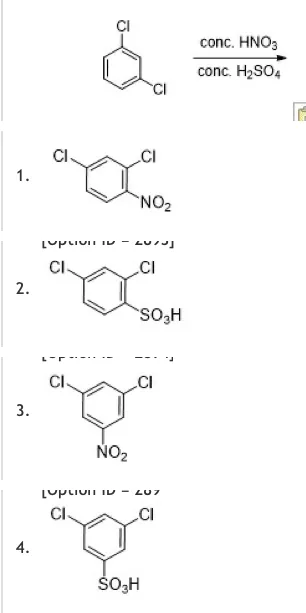
The major product formed in the following reaction is
A2,4-dichloro-1-nitrobenzene
B2,4-dichlorobenzenesulfonic acid
C1,3-dichloro-5-nitrobenzene
D3,5-dichlorobenzenesulfonic acid
Show answer and explanation
Answer: A. 2,4-dichloro-1-nitrobenzene
In 1,3-dichlorobenzene, chlorine acts as an ortho/para director. Position 4 is ortho to one chlorine and para to the other, so both substituents reinforce directing the nitronium ion (NOX2X+) to this carbon, with minimal steric hindrance compared to position 2. Electrophilic nitration outcompetes sulfonation, and substitution does not occur meta to both chlorines as in C.
102 more questions from this paper are in the app
In the Tatva app you get the whole paper with the real clock and marking, every answer explained, your score, and an AI tutor for each mistake.