For the given reaction [X∗X22∗Co(L)n]2++[Co(L)n]3+→[X∗X22∗Co(L)n]3++[Co(L)n]2+ the correct statement with respect to the rate of electron transfer process is o-phen = o-phenanthroline; X∗X22∗Co is labeled atom
Afast electron transfer; L=NHX3; n=6
Bslow electron transfer; L=o-phen; n=3
Cvery slow electron transfer; L=NHX3; n=6
Dvery slow electron transfer; L=o-phen; n=3
Show answer and explanation
Answer: C. very slow electron transfer; L=NHX3; n=6
For L=NHX3 (n=6), the self-exchange involves high-spin [Co(NHX3)X6]X2+ (t2g5eg2) and low-spin [Co(NHX3)X6]X3+ (t2g6eg0). This process entails a spin-state change and a large difference in Co−N bond lengths (≈0.22A˚), creating a huge Franck-Condon reorganization barrier that makes electron transfer extremely slow (k∼10−6M−1s−1). In contrast, [Co(o-phen)X3]X2+/3+ undergoes much faster exchange due to rigid π-acceptor ligands and smaller bond length changes, ruling out options B and D.
Choose the correct order of energy of 2σg and 1πu molecular orbitals for BX2, CX2 and OX2:
A2σg>1πu for all the three
B2σg>1πu for BX2 and CX2 only
C1πu>2σg for CX2 and OX2 only
D2σg>1πu for BX2 and OX2 only
Show answer and explanation
Answer: B. 2σg>1πu for BX2 and CX2 only
Due to strong s-p mixing in lighter homonuclear diatomics (Z≤7), the σ2p (2σg) molecular orbital is raised above the π2p (1πu) orbitals in BX2 and CX2, giving 2σg>1πu. In OX2, the large energy gap between the 2s and 2p atomic orbitals prevents significant mixing, maintaining the normal order 1πu>2σg. Option A fails because it incorrectly assumes s-p mixing occurs to the same extent in OX2.
The pair in which both actinides show +3 oxidation state only is
AAc and Lr
BAc and No
CCm and Bk
DCm and Lr
Show answer and explanation
Answer: A. Ac and Lr
Ac ([Rn]6d17s2) and Lr ([Rn]5f147s27p1) lose their outermost valence electrons to achieve exceptionally stable closed-shell [Rn] and [Rn]5f14 configurations, respectively, making +3 their only oxidation state. In contrast, No in option B primarily shows a stable +2 state due to its filled 5f14 configuration, while both Cm and Bk (options C and D) also exhibit +4.
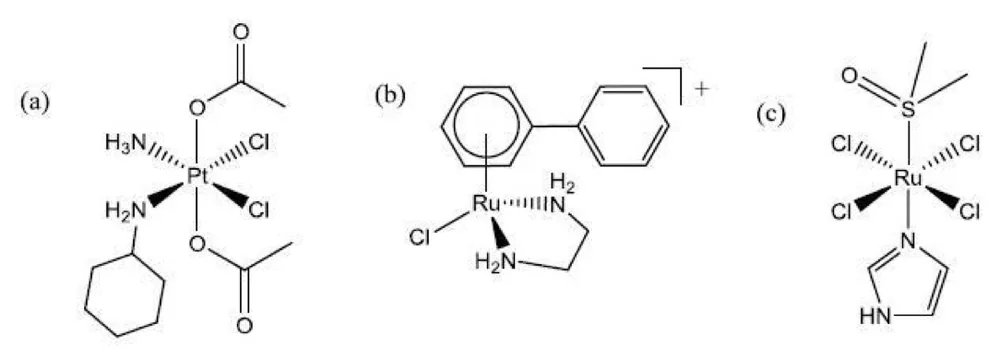
The complex(es) showing activity against cancerous cells is/are
A(a) only
B(a) and (b) only
C(a) and (c) only
D(a), (b) and (c)
Show answer and explanation
Answer: D. (a), (b) and (c)
All three structures are prominent metal-based anticancer agents. Complex (a) is satraplatin, an orally active Pt(IV) prodrug reduced intracellularly to bind DNA. Complex (b) is a Sadler-type Ru(II)-arene half-sandwich complex with potent antitumor activity, while (c) is the core of NAMI-A, a landmark Ru(III) drug that entered clinical trials against tumor metastases. Because every complex exhibits anticancer efficacy, options A, B, and C are incomplete.
Consider the nuclear reaction X92X2922XX234+βX−+αY+γX+2βX+
Y is
AX92X2922YX238
BX91X2912YX238
CX93X2932YX236
DX94X2942YX238
Show answer and explanation
Answer: B. X91X2912YX238
Balancing the mass number gives 234+0+4=A+0+2(0), so A=238. Balancing the nuclear charge gives 92+(−1)+2=Z+0+2(+1), which simplifies to 93=Z+2, yielding Z=91. Hence, the nuclide formed is X91X2912YX238. Option A incorrectly ignores the +2 charge contribution from the two emitted positrons.
Correct statement/s among the following with respect to ionization energy (IE) is/are
(i) (IE1+IE2+IE3) for indium is more than that of aluminium
(ii) IE1 of scandium is higher than that of cobalt
(iii) IE1 of gallium is lower than that of selenium
(iv) IE1 of nitrogen is greater than that of oxygen
A(ii) and (iv)
B(iii) and (iv)
C(i) and (iv)
D(ii) and (iii)
Show answer and explanation
Answer: B. (iii) and (iv)
Across Period 4, effective nuclear charge increases, so IE1 of gallium (579 kJ mol−1) is lower than that of selenium (941 kJ mol−1), making (iii) correct. Nitrogen has an exceptionally higher IE1 than oxygen due to its stable half-filled 2p3 subshell and the absence of electron-pairing repulsion found in oxygen's 2p4 configuration, making (iv) correct. Option A and D fail because IE1 increases from Sc (633 kJ mol−1) to Co (760 kJ mol−1), so statement (ii) is false.
The reason for significantly high solubility of AgClOX4 in benzene than in alkane solvents is
AAlkane solvents are non- polar.
BBenzene is an aprotic solvent.
CPhAg is formed.
DBenzene acts as a soft base
Show answer and explanation
Answer: D. Benzene acts as a soft base
According to HSAB theory, AgX+ is a soft Lewis acid and the polarizable π-electron system of benzene behaves as a soft base, forming a stable cation-π complex that solvates the salt. Alkanes have no donor π-electrons to coordinate to AgX+. Option A is incomplete because benzene itself is also non-polar, so non-polarity cannot account for the contrast.
Correct statement for 'Inductively Coupled Plasma Atomic Emission Spectroscopy' is
AIt is unsuitable for all non-metals.
BSimultaneous determination of only metals is possible.
CInduction coil stabilizes plasma.
DOxide formation lowers atomization of metals.
Show answer and explanation
Answer: C. Induction coil stabilizes plasma.
In ICP-AES, a radio-frequency induction coil supplies energy via an oscillating electromagnetic field to continuously sustain and stabilize the high-temperature (6000–10000K) argon plasma. These extreme temperatures effectively eliminate chemical interferences by completely dissociating refractory oxides, making option D incorrect. Non-metals such as P, S, and halogens are also readily detected, which rules out options A and B.
The number of geometrical isomers of the complex [RhH(C≡CR)X2(PMeX3)X3] is
A2
B3
C4
D1
Show answer and explanation
Answer: B. 3
The octahedral complex belongs to the [MabX2cX3] type, where the three PMeX3 (c) ligands can adopt either a *fac* or a *mer* geometry. The *fac* arrangement offers three equivalent sites for one H (a) and two C≡CR (b) ligands, yielding only 1 isomer. The *mer* arrangement yields 2 distinct isomers depending on whether the two C≡CR groups are mutually *trans* or *cis*, giving 1+2=3 geometrical isomers in total. Option A misses one of the *mer* configurations.
IX2 is violet in the solid as well as in gas phase. However in acetone or ethanol, it turns brown. Choose the correct statement(s) for this colour change: (a) Dissociation of IX2 in atomic state (b) Interaction of low-lying σ∗-orbital of iodine with lone pair of O (solvent) (c) Formation of a charge-transfer complex
A(a) only
B(b) only
C(a) and (b) only
D(b) and (c) only
Show answer and explanation
Answer: D. (b) and (c) only
In electron-donor solvents such as acetone or ethanol, the lone pair on the oxygen atom donates electron density into the low-lying σ∗ LUMO of IX2, forming a charge-transfer (CT) complex. This donor-acceptor interaction shifts the absorption band toward higher energy (blue shift), changing the observed violet colour to brown. Option C fails because IX2 remains as an intact molecule in the adduct rather than dissociating into free iodine atoms.
108 more questions from this paper are in the app
In the Tatva app you get the whole paper with the real clock and marking, every answer explained, your score, and an AI tutor for each mistake.