

Tatva

CSIR NET Chemical Sciences

CSIR NET Jun 2018: questions with answers and explanations

10 of the 119 questions, with answers and explanations. The full paper is in the Tatva app. Answers follow the official final key.

Question 21Main group
Dinuclear anion has two bridging oxo groups. The geometry around each iodine is
  1. Aoctahedral
  2. Bmonocapped octahedral
  3. Csquare pyramidal
  4. Dpentagonal bipyramidal
Show answer and explanation

Answer: A. octahedral

In , the two centers are connected by two bridging oxo ligands (-). Each iodine is further coordinated by three terminal oxo groups and one terminal hydroxo group, giving a total coordination number of in an edge-sharing bioctahedral framework. Thus, the local coordination geometry around each iodine is octahedral; option C is ruled out because it assumes a coordination number of 5.
Question 22Spectroscopic methods
Using a double beam UV-visible spectrophotometer, Beer's law fails for solution when
  1. Aintensity of light source is changed
  2. Bdetector is not a photomultiplier tube
  3. Ccuvette of size is used
  4. DpH is not kept same in all measurements
Show answer and explanation

Answer: D. pH is not kept same in all measurements

In aqueous solution, dichromate exists in a pH-dependent chemical equilibrium: . Because and have distinctly different absorption spectra and molar absorptivities, varying the pH shifts this equilibrium and changes the relative concentrations of the absorbing species, resulting in an apparent deviation from Beer's law. In contrast, increasing the cuvette path length to (option C) simply scales absorbance linearly according to without causing Beer's law to fail.
Question 23Lanthanides and actinides
Tri-positive lanthanide ion having isotropic magnetic behaviour is
  1. A
  2. B
  3. C
  4. D
Show answer and explanation

Answer: B.

has a half-filled electronic configuration with an ground state, giving a total orbital angular momentum of . Because , the ion experiences negligible spin-orbit-induced anisotropy, rendering its magnetic susceptibility isotropic. In contrast, (D) is entirely diamagnetic (, ), while ions like (A) have non-zero orbital contributions from thermally accessible excited states.
Question 24Main group
The structure of is close to that of
  1. Acesium chloride
  2. Bnickel arsenide
  3. Crock salt
  4. Dzinc blende
Show answer and explanation

Answer: A. cesium chloride

In , rigid octahedral units and ions form two interpenetrating simple cubic sublattices, placing each cluster at the center of a cube of atoms (8:8 coordination). This arrangement directly mimics the lattice. Option C fails because rock salt is an fcc-based framework with 6:6 coordination rather than simple cubic 8:8 packing.
Question 25Organometallics
The correct order of bond length is
  1. A
  2. B
  3. C
  4. D
Show answer and explanation

Answer: B.

Greater metal-to-ligand -backdonation fills the orbital, decreasing the bond order and lengthening the bond. Among the isoelectronic complexes, backbonding increases with higher negative charge: . In , the non-metal boron lacks d-electrons to backdonate, yielding the shortest bond. Option A gives the reverse order because it confuses bond length with stretching frequency.
Question 26Periodic trends
Among the elements , , and , the one with the lowest first ionization energy is
  1. A
  2. B
  3. C
  4. D
Show answer and explanation

Answer: C.

Across Period 4, has the electronic configuration , where removing the solitary electron yields a stable, fully-filled subshell configuration () and experiences significant shielding from the inner electrons. Consequently, its first ionization energy is exceptionally low () compared to and . Option B is incorrect because () requires removing an electron from a fully filled, more penetrating orbital, leading to a much higher ionization energy ().
Question 27Term symbols
The total degeneracy of the ground term of (high spin) in octahedral geometry is
  1. A18
  2. B12
  3. C28
  4. D9
Show answer and explanation

Answer: B. 12

The key also accepts C.

The official key gives C (28), but 28 is the degeneracy of the free-ion term, .
The question asks for the ground term in octahedral geometry. There the term splits into , and for high-spin the lowest is .
Its total degeneracy is spin orbital , which is option B.
Question 28Organometallics
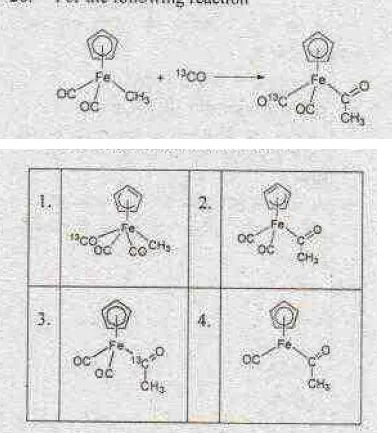
For the following reaction

the structure of the intermediate is
Question 28
  1. AStructure (1)
  2. BStructure (2)
  3. CStructure (3)
  4. DStructure (4)
Show answer and explanation

Answer: D. Structure (4)

Migratory insertion in the 18-electron complex proceeds via intramolecular migration of the methyl group onto an existing, coordinated ligand. This generates the 16-electron acyl intermediate with a vacant coordination site, represented by structure 4. The incoming then traps this species to yield the labeled product. Structure 1 (option A) incorrectly assumes an associative pathway involving an unfavorable 20-electron intermediate.
Question 29Magnetism
High spin complex of a metal ion has a magnetic moment of in octahedral coordination environment and in tetrahedral environment. The ion is
  1. A
  2. B
  3. C
  4. D
Show answer and explanation

Answer: B.

An ion with two unpaired electrons (, ) has a spin-only magnetic moment of . In an octahedral field, has an -term ground state () where orbital contribution is quenched, yielding , whereas in a tetrahedral field it has a -term ground state () with unquenched orbital angular momentum, raising to . Option D (, ) has three unpaired electrons and gives much higher moments () in both geometries.
Question 30Electronic spectra
For electronic spectra of (A) and (B) the correct combination is
  1. Atransition is and for
  2. Btransition is LMCT and for
  3. Ctransition is LMCT and for
  4. Dtransition is MLCT and for
Show answer and explanation

Answer: C. transition is LMCT and for

Both and are metal ions, so transitions are absent and the observed bands arise from LMCT (). Because is smaller, more electronegative, and more easily reduced than , the LMCT transition energy is lower for than for (). Consequently, gives . Option B incorrectly predicts a higher excitation energy for chromate.

109 more questions from this paper are in the app

In the Tatva app you get the whole paper with the real clock and marking, every answer explained, your score, and an AI tutor for each mistake.

  • Organic31
  • Physical25
  • Inorganic24
  • General Aptitude20
  • Spectroscopy7
  • Analytical2

More CSIR NET Chemical Sciences papers